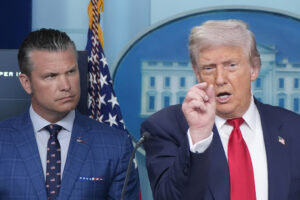
In one particularly poignant essay, NPR correspondent Tom Bowman, who opted to give up a Pentagon press pass he has held for nearly 30 years, explained how the new rules would have impeded crucial reporting on the Iraq and Afghanistan wars and other defense operations. “Yes, we’ve received solicited and unsolicited information on everything from failed policies and botched military operations that led to unnecessary military and civilian deaths, to wasteful government projects that both Democratic and Republican administrations would rather stay in the shadows,” Bowman wrote. “That’s our job.”
During the weeks between the Defense Department’s announcement of its new rules and the deadline for news organizations to decide whether to accept them, the Ethics and Journalism Initiative asked NYU journalism ethics professors to weigh in on the advice they’d offer to media outlets. As you can see, some of their thoughts look quite prescient now that the news industry has taken a unified stand in favor of free and independent reporting.
Read their full ethics analysis here
Upcoming events

Register here (registration required)
Please join us, in partnership with NYU’s Science, Health, and Environmental Reporting Program, for an in-person “Lunch and Learn” panel with some of the leading voices in reporting on the climate crisis. We’ll explore how climate reporters can track real-time disasters, invite a range of perspectives in their reporting, communicate scale and impact, offer resources, and serve their audiences without alienating them.
Panelists include:
Emily Atkin, author and founder of HEATED, a Monday-Thursday newsletter dedicated to original accountability reporting and analysis on the climate crisis.
David Sassoon, founder and publisher of Inside Climate News.
Somini Sengupta, international climate reporter on the New York Times climate team.
The event will be moderated by Dan Fagin, director of the Science, Health, and Environmental Reporting Program.
Decoded

Until last January, the National Trust for Local News had no unifying code of standards and ethics for the 30 or so local newspapers it operates and funds across Maine, Georgia, and Colorado. Some of the newspapers – which range from community weeklies with just a handful of journalists on staff to The Portland Press Herald, the daily flagship of Maine’s largest network of independent news outlets – had their own policies, according to Amalie Nash, the National Trust’s former head of transformation. But those codes were a hodgepodge. Some were outdated. None addressed AI. And many of the newspapers had no formal ethics codes at all.
Over about six months in late 2024, Nash worked with editors at National Trust outlets to develop an ethics handbook that sets policies for all of the Trust’s newspapers. The new guidelines took effect on Jan. 13, 2025.
“The genesis of the project was believing it was important to have overarching ethical policies covering all of our journalists– policies that will be regularly taught and updated,” said Nash, a onetime senior vice president of local news and audience development for Gannett. (Nash moved in September from the National Trust to the Knight Foundation.) “We felt like it was important to have updated and comprehensive policies that would cover all of the newsrooms and be publicly accessible so that readers could see the ethics we abide by.”
Read more about the Trust’s decision-making
🏆 COLLIER AWARDS
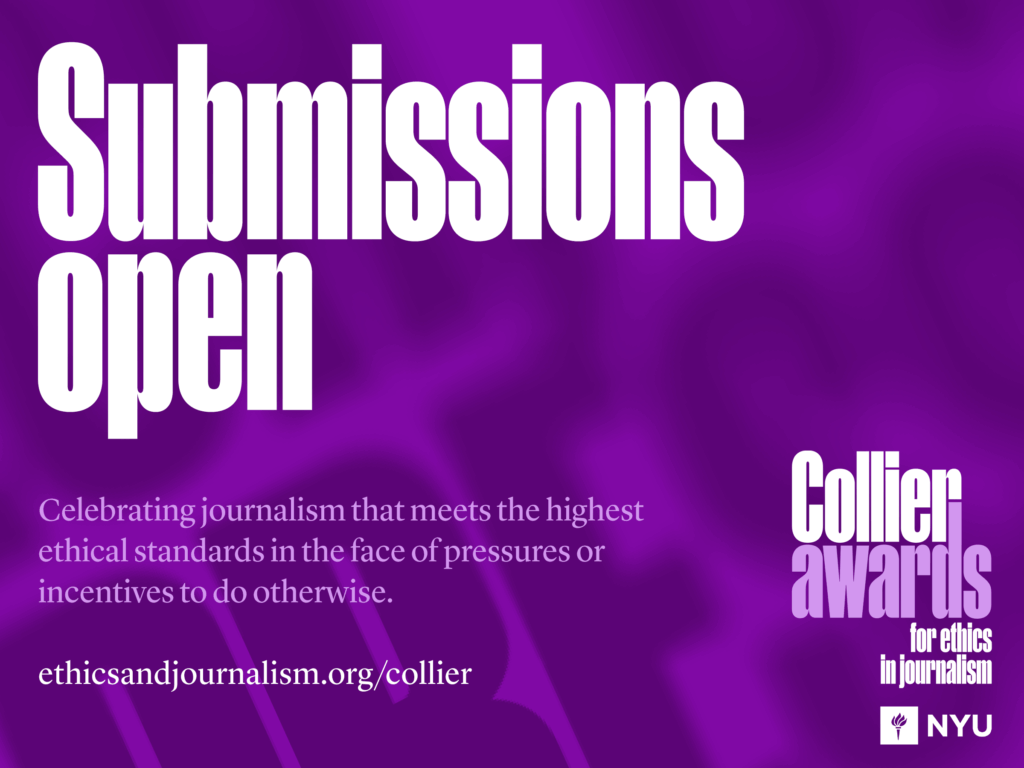
Start your submission today! Deadline: December 9
Earlier this month, Initiative Director Stephen Adler delivered the keynote address at the “Journalism and Good Governance” conference at the University of Navarra School of Communication in Madrid, Spain. We’ve published an excerpt addressing future challenges in journalism and the news business on our site, with the hope that it offers not simply a litany of issues but a word of encouragement and vigorous defense of the value of courageous, ethical, and independent journalism.
Read the speech here
Henry Luce is sometimes given credit for solidifying the separation of church and state in American journalism, with his insistence on a wall between editorial and business functions at Time Inc. publications. He didn’t come up with the idea, though—in 1869, literary critic Richard Grant White was already declaring that “nothing in the interests of an advertiser, no matter what his importance, shall be admitted into the editorial columns for any consideration.” Nor was Luce as much of a purist as his reputation might suggest. Not only was he, perhaps ironically, editor and executive at the same time, but he also said that, “If we have to be subsidized by anybody, we think that the advertiser presents extremely interesting possibilities.” He knew no newsroom can exist without a business side, and in fact he went on to say that, while he only wanted to compromise a tiny bit of integrity, a “small fraction of our journalistic soul” he would happily sell.
Today, in my role as managing editor at TIME, Luce’s flagship publication, I think every day about how to coordinate between the editorial department and our colleagues on the business side in a way that both supports our company and protects our integrity. The question often presents as a logistical one (about who should get access to which Airtable, for example), but its urgency has never been clearer. It’s not news that ours is a moment of precarity for the news business, in terms of both finances and trust—an era when most Americans believe that most news outlets are primarily motivated by their own monetary interests. And so, as part of the 2024 cohort in the Executive Program in News Innovation and Leadership at CUNY’s Craig Newmark Graduate School of Journalism, I took a look at the state of “the Wall” and where things stand in terms of best practices for a workable vision of its future.
Read more about Rothman’s findings from her survey of industry professionals and news leaders
Being human, journalists sometimes make mistakes. That’s why newsrooms typically have guidelines for what to do when they accidentally publish something that is incorrect. But, in a period of persistent public distrust of the news media, explaining these guidelines directly to readers is equally important.
Last week, The Concord Monitor published a piece just that, as part of Know Your News, a joint initiative of Granite State News Collaborative and NENPA Press Freedom Committee on “why First Amendment, press freedom, and local news matter.” Read the full article here, which cites the NYU Ethics and Journalism Initiative’s Best Practice on the topic.
Best Practices Archive
Have thoughts on something you’ve read here today or a journalism ethics topic in the news? We’d like to hear what you have to say and may feature your comments in a coming newsletter. You can drop us an email at ryan.howzell@nyu.edu or reach us on Linkedin, Bluesky, X, and Instagram.