Trump vs. BBC vs. CBS (Ethically Editing Broadcast Footage); Accountability & Sourcing in Climate Journalism; Rethinking Mug Shots & Perp Walks; Doing Transparency Right; Should Journalists Promote Democracy?; Apply to Collier Award!
Ethics Insight What the BBC did wrong (and CBS didn’t): A Q&A with NYU professor and TV news legend Joe Peyronnin
by Alison Frankel
Senior Advisor
President Donald Trump’s latest confrontation with the media cost top BBC director general Tim Davie and head of news Deborah Turness their jobs this month. The top-ranking British broadcast executives resigned on Nov. 9, after the leak of an internal report that criticized the network’s election-eve documentary about the president. The report accused the BBC of splicing together clips from Trump’s Jan. 6, 2021, speech on the National Mall in an effort to make it appear that he had urged supporters to riot at the U.S. Capitol. In Trump’s actual speech, the spliced-together comments were separated by nearly 50 minutes.
A general view of the BBC headquarters in London, Sunday, Nov, 11, 2012. (AP Photo/Alastair Grant)
Trump has threatened to sue the BBC over the documentary, following his $16 million settlement with CBS News’ parent for allegedly deceptive editing of a 60 Minutes interview with Democratic presidential nominee Kamala Harris. On Nov. 13, the BBC apologized to Trump but said it would not pay any compensation for the documentary.
For insight on the ethical implications of the two incidents, EJI senior advisor Alison Frankel spoke with NYU adjunct journalism professor Joe Peyronnin, a longtime television news executive who spent 40 years at CBS News, Fox News, and Telemundo/NBC News.
Event recap What Is Ethical Climate Journalism? HEATED’s Emily Atkin, Inside Climate News Founder David Sassoon, and New York Times Reporter Somini Sengupta Weigh In
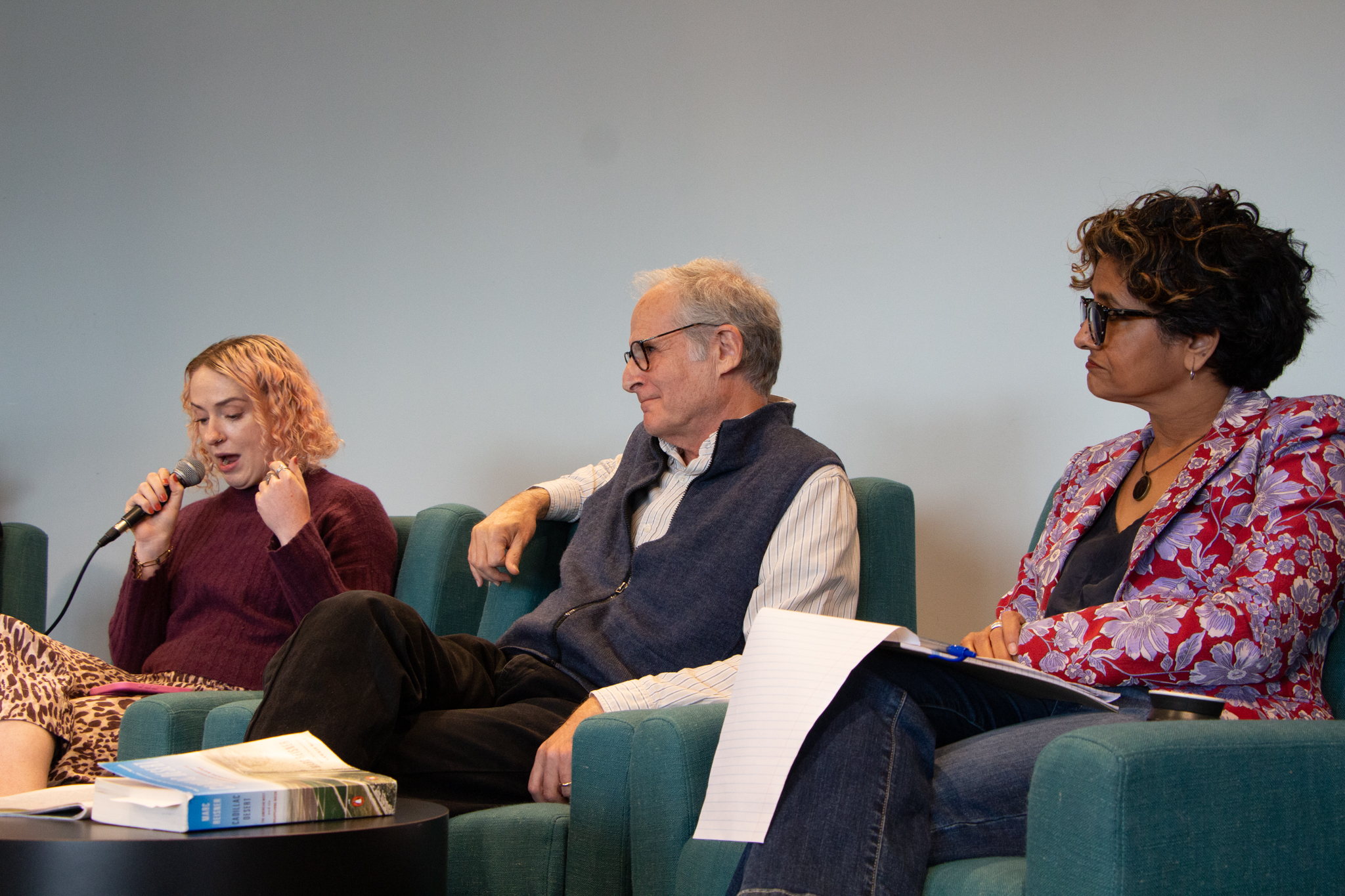
A trio of seasoned climate reporters convened at New York University to discuss story selection, seeking comment from unsympathetic sources, and balancing coverage of individual and systemic issues.
When David Sassoon founded Inside Climate News (ICN) in 2007, he knew that shifting the climate information landscape would be an uphill battle: “You come to the climate issue, and you’re immediately confronted with a lot of unethical behavior that is flooding the zone,” he said“The level of deliberate misinformation for decades, and the amount of money that is behind it, is one of the first things you have to contend with and look at squarely.”
Nearly 20 years later, ICN’s nonprofit newsroom employs reporters in bureaus across the United States and has become a hub for in-depth, climate-focused journalism that is free to readers and regularly reprinted by local outlets. As a publisher, Sassoon recognizes that fighting a behemoth requires working together. “We are not in the competitive game of journalism, because in this circumstance, what’s most important is solidarity. There are fewer of us, there are fewer resources, and so we are all about collaboration,” Sassoon said during “Urgency, Uncertainty and Alarmism: Ethical Climate Coverage,” an October panel co-hosted by the New York University Ethics and Journalism Initiative and the University’s Science, Health, and Environmental Reporting Program (SHERP).
Persistence – in meeting the diverse information needs of communities and countering misinformation – was a recurring theme throughout the two-hour event, which brought together journalists from nonprofit, legacy, and digital-first publications. In addition to Sassoon, the panelists included Emily Atkin, author and founder of HEATED, a popular climate newsletter published on Substack, and Somini Sengupta, an international climate reporter on TheNew York Times climate team. The event was moderated by Dan Fagin, a Pulitzer-Prize-winning environmental journalist and SHERP’s director.
Watch the full event video feat. audience questions on AI use in climate reporting and covering climate activism below:
🏆 Collier awards It’s Time to Get Started On Your Collier Awards Submission (Student, Local, and National Categories)
Deadline: Monday, December 8, 2025
In your reporting in the last year, did you or your newsroom publish a story that involved particularly complicated or sensitive sourcing? Did you find yourself weighing potential harm and privacy considerations, while also fulfilling your commitment to report thoroughly on newsworthy topics? Did you consider how to leverage AI ethically in your work? Did you pursue balanced coverage while avoiding false equivalencies?
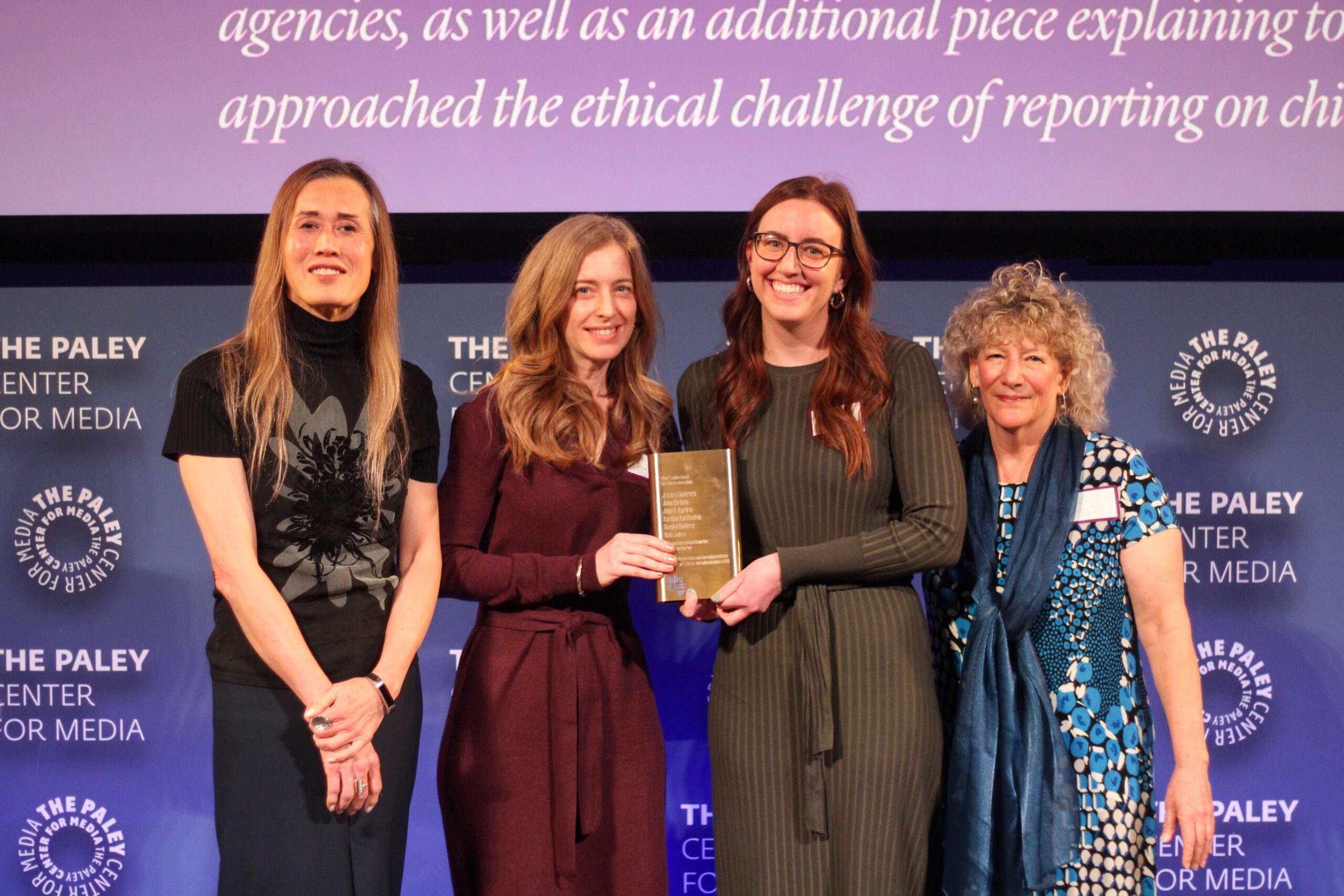
Your work may deserve a Collier Award for Ethics in Journalism. The Collier Awards recognize outstanding work in student, local, and national/international categories, offering $15,000 cash prizes. We celebrate not just what you publish, but the complex and challenging decision-making that got you here. To get a better sense of what we’re looking for, read about last year’s winners at https://ethicsandjournalism.org/collier/awardees/.
To learn more about the award and the application process, visit our How to Apply page or email Ethics and Journalism Initiative Deputy Director Ryan Howzell with any questions.
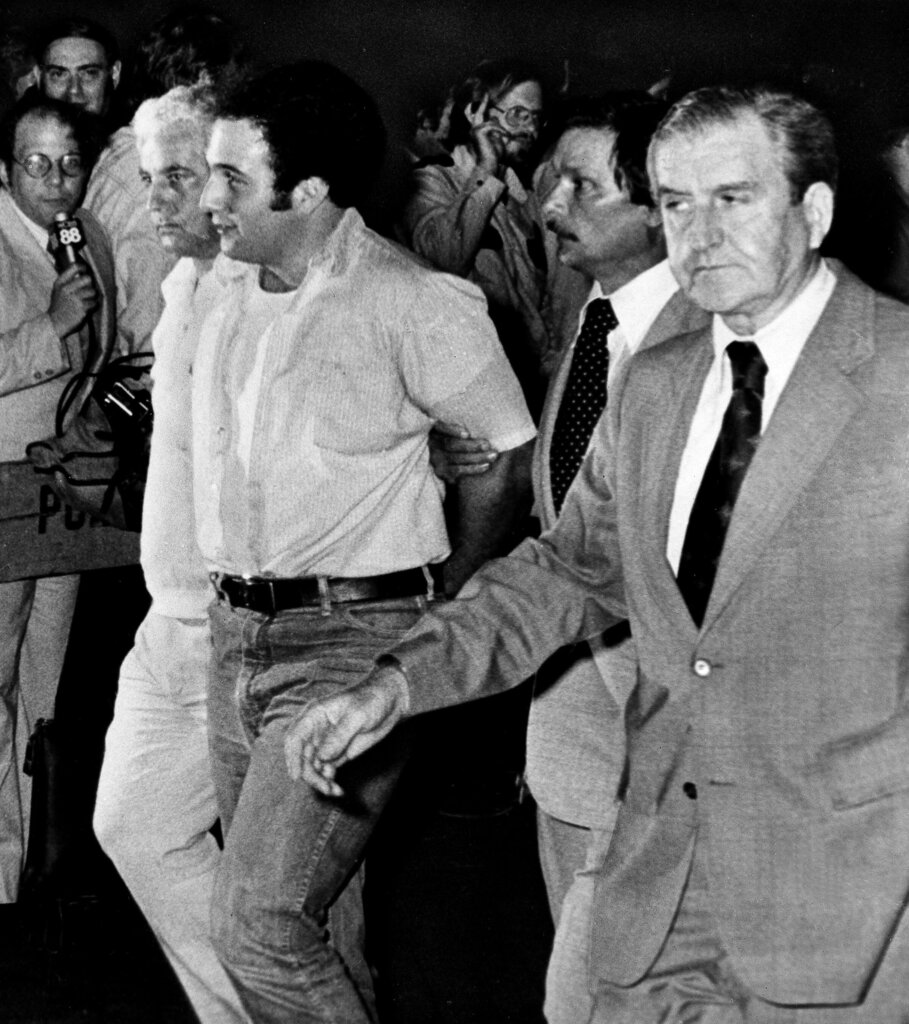
No one looks innocent when photographed standing against the wall at a police station for a mugshot or being escorted in handcuffs by a bevy of law enforcement officers in a so-called perp walk. As The New York Times noted in a 2018 retrospective on perp walks, even Mother Theresa would look shady under such circumstances.
Mugshots and perp walks have nevertheless been a staple of news coverage for decades. It’s hard to resist when law enforcement sources tip your newspaper or television station about splashy arrests so reporters can be on site, cameras ready, to witness a high-profile defendant being hauled into custody. And for resource-strapped newsrooms, it’s cheap and easy to illustrate crime stories with mugshots distributed by police departments and sheriff’s offices.
We think it’s well past time for journalists to rethink the routine use of these images. Read about why we advise discernment when publishing these photos (and alternate photos to consider).
local spotlight The Minnesota Star Tribune Opts for Radical Transparency on Major Scoop
The newspaper’s investigative team showed its work in a lengthy editor’s note accompanying an investigative story on the Trump administration’s planning for Portland military operations.
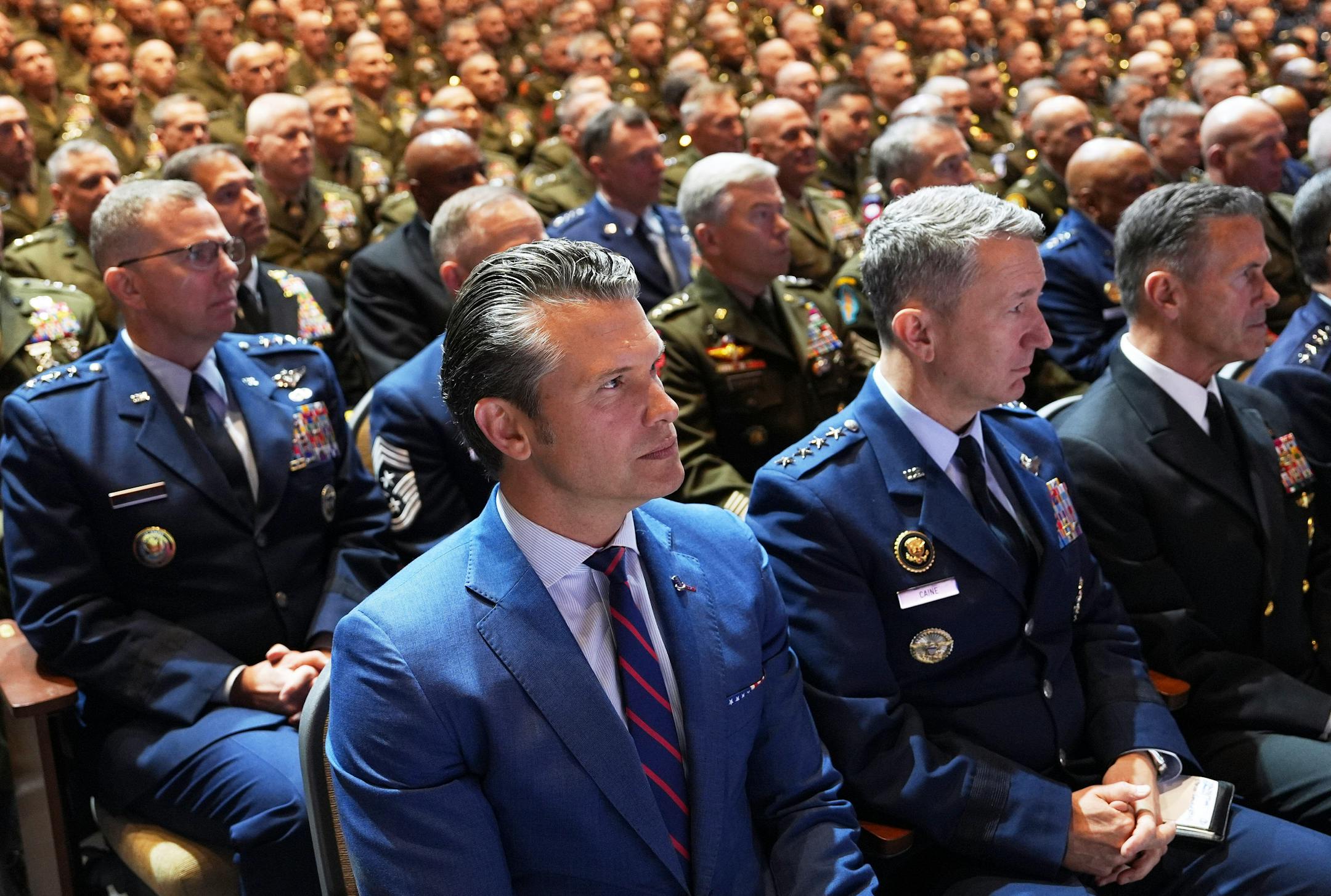
Defense Secretary Pete Hegseth, center, with U.S. military senior leadership as they listen to President Donald Trump at Marine Corps Base Quantico in Quantico, Va., on Tuesday. (Evan Vucci/The Associated Press)
A lead story from the Minnesota Star Tribune last month was a startling scoop: The newspaper reported that U.S. Defense Secretary Pete Hegseth considered sending the army’s elite 82nd Airborne Division – a legendary strike force that has been deployed to combat zones around the world – to Portland, Oregon, in response to protests at an ICE facility.
As the story explained, the Star Tribune learned of the potential plan to deploy active U.S. troops to a U.S. city from an anonymous source who witnessed a White House official exchanging text messages with other high-ranking Trump officials in a crowded public place. The source, who, according to the Star Tribune, was “troubled by seeing sensitive military planning discussed so openly,” photographed the official’s text exchanges and shared them with Star Tribune investigative reporter Andy Mannix.
From a journalism ethics perspective, a 600-word editor’s note that accompanied the scoop was almost as startling as the story itself.
IN THE NEWS Should Journalists Promote Democracy? (Event Video)
A free press is so essential to democracy that the U.S. Constitution enshrines press freedom in its First Amendment. But when democratic norms are under attack, what’s the best way for journalists to serve the lofty mission of protecting and defending constitutional values? Is it by highlighting and advocating against a government’s autocratic impulses? Or by providing fair, honest, factual reporting that enables news audiences to make up their own minds?
Initiative founder and director Stephen Adler was one of four eminent journalists who discussed those crucial questions at a Nov. 3 panel discussion hosted by the Lipman Center for Journalism and Civil and Human Rights and the Toni Stabile Center for Investigative Journalism at Columbia University. Adler was joined by Maria Ressa of the Institute of Global Politics, who was awarded the 2021 Nobel Peace Prize for her courageous work as a journalist in the Philippines, and by editor and columnist Margaret Sullivan, the executive director of the Craig Newmark Center for Journalism Ethics and Security at Columbia. The panel was moderated by Stabile Center director Sheila Coronel.
Watch the hour-long video to see Adler, Sullivan, Ressa, and Coronel discuss questions including whether journalists should participate in protests, how local journalism can rebuild the industry’s credibility, and why journalists should, in Sullivan’s words, get out of their “defensive crouch” and embrace their power, even if it’s limited, to effect change.
Read More
The New York Times offers a birds-eye overview of different AI use cases in newsrooms (featuring a comment from EJI). For a deeper look, check out our lengthy Q&A with Andrew Deck, AI Staff Writer for Nieman Lab.
Also in Nieman Lab, an innovative partnership between Boston University student journalists and hyperlocal outlets. The result? In the past year, nearly 400 rigorously edited stories by students have reached local audiences.
From Al Jazeera, did journalist Michael Wolff’s deep source relationship with Jeffrey Epstein strengthen or ethically compromise his reporting?
From The Conversation: Thanks to their reach on social media, online influencers have begun to outstrip traditional journalists in political coverage. But UC Berkeley professor Edward Wasserman argues that influencers still have more than a few things to learn from the mainstream media when it comes to transparency and ethics.
Bill Grueskin’s weekly Laurels and Dartscolumn for the Columbia Journalism Review. This week, he analyzes reporting on ICE raids, political candidates’ personal lives, investigations into an Oklahoma superintendent, and the faces behind the Venezuelan narcotics trade and Trump’s air strikes.
We Want to Hear From You
Have thoughts on something you’ve read here today or a journalism ethics topic in the news? We’d like to hear what you have to say and may feature your comments in a coming newsletter. You can drop us an email at ryan.howzell@nyu.edu or reach us on Linkedin, Bluesky, X, and Instagram.
Journalism Done Right: The 2026 Collier Awardees
Delve into the extraordinary reporting from the nine awardees of the 2026 Collier Awards for Ethics in Journalism, including The Associated Press, Miami Herald, and Stanford Daily.