
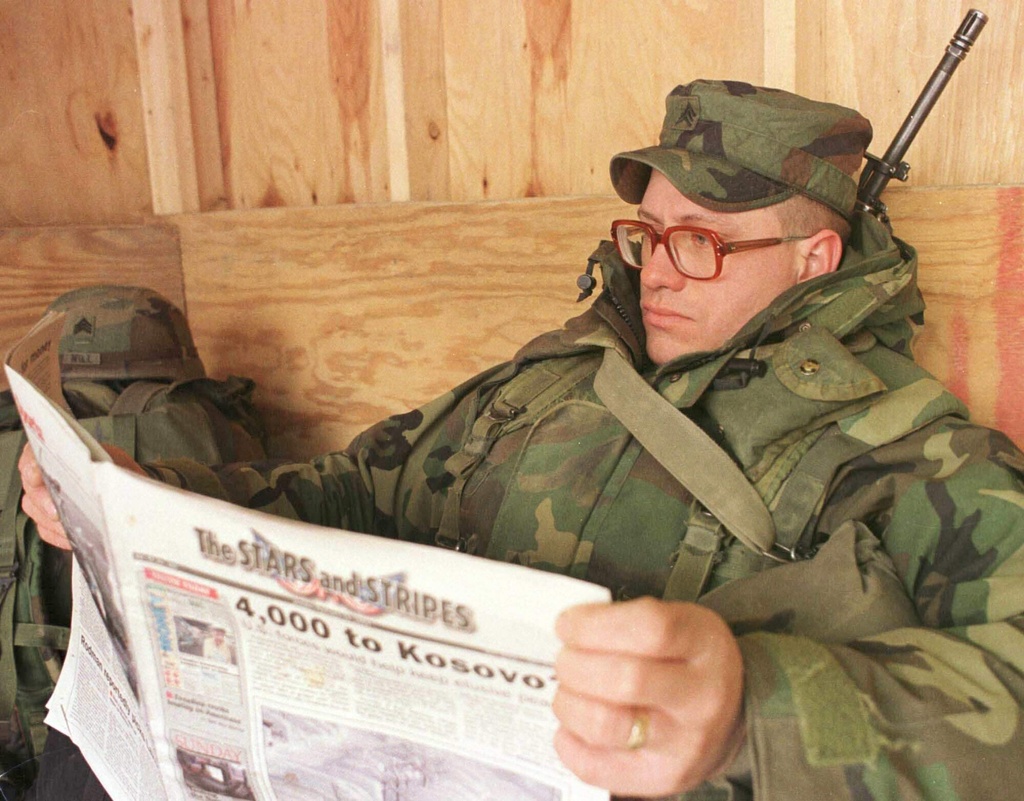

Last July, when Star and Stripes editor-in-chief Erik Slavin spoke to CBS News about the U.S. Defense Department’s escalating encroachment on the newspaper’s independence, he highlighted one of the most basic tenets of journalism ethics.

Former Stars and Stripes Editor-in-Chief Erik Slavin, Kaiserslautern, Germany, September 4, 2025. (Michael Abrams/Stars and Stripes)
If the Pentagon were to insist that he ditch a “perfectly accurate” story and instead run a piece written by the Defense Department, Slavin said, that would be a red line. “We need to be able to provide independent news to service members,” he told CBS’ David Martin, who asked if there was a foxhole Slavin would be willing to die in. “If we can’t do that, if we were turned into something other than that, if we were public relations? Yeah, that’s the foxhole.”
Stars and Stripes’ Middle East correspondent, Lara Korte, told CBS that she, too, was committed to providing independent news to the service members and their families who rely on the newspaper for coverage of the military.
“I’m working for Stars and Stripes,” Korte said. “Not for the Pentagon, not for any administration, not for any policymaker.”
As Slavin would later write in The Atlantic, no self-respecting journalist in a free society would disagree with the principles he and Korte laid out in the CBS interview.
Yet in late August, several weeks after CBS aired its story about the Pentagon’s attempts to tighten its control over Stars and Stripes – and days after Stars and Stripes broke news about troubling conditions on an aircraft carrier stationed for months in the Arabian Sea – Defense Department officials fired Slavin and Korte for insubordination, citing their comments to CBS. The Pentagon also fired Stars and Stripes publisher Max Lederer, who earlier that month had announced that he would retire instead of complying with instructions to fire Slavin and Korte.
Slavin and Korte spoke with the Ethics and Journalism Initiative about working at Stars and Stripes – and defending its independence – as the Defense Department ratcheted up its pressure on the newspaper. They found themselves in a situation that, as EJI founder and director Stephen Adler has warned, is likely to become more commonplace for journalists in an age of heightened economic and political pressure on newsrooms. And by their telling, they and their colleagues stuck by ethical principles.
Slavin, Korte, and Lederer filed a lawsuit in federal court on August 27, arguing that Defense Department officials violated their First Amendment rights and failed to follow proper procedures in firing them. Federal judge Trevor McFadden denied their motion to enjoin the Pentagon from terminating their employment on Sept. 4, ruling that Slavin and Korte spoke to CBS in an official capacity as Defense Department employees so they are not protected by the First Amendment.
One of their lawyers, David Seide of the Government Accountability Project, said Slavin, Korte, and Lederer will continue to pursue their procedural claims before McFadden.
The Defense Department provided a statement from Pentagon public affairs chief Sean Parnell. “Stars and Stripes is a Department of War publication funded to inform the military community,” the Parnell statement said. “The Department has both the authority and the responsibility to ensure it remains focused on the force — warfighting, readiness, and the men and women who serve — rather than becoming a platform for airing employee grievances.” A Pentagon spokesperson declined additional comment on the Stars and Stripes controversy, citing the pending litigation.
I also emailed Stripes’ acting U.S. bureau chief and its general news mailbox for comment on how the Defense Department actions had affected the newsroom but did not hear back.
A History of Independence
Stars and Stripes, which dates all the way back to the Civil War, has an unusual relationship with the Defense Department. The newspaper’s mostly-civilian staff members are employees of the Pentagon, which provides roughly half of the news services revenues. Stars and Stripes journalists working abroad have offices on military bases.
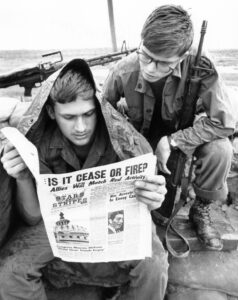
FILE – A GI with the U.S. 25th division reads Stars and Stripes newspaper at Cu Chi, South Vietnam on Sept. 10, 1969. (AP Photo/Mark Godfrey)
But Stripes, as the newspaper is widely known, has a Congressional mandate to provide independent news to the U.S. military community. (In 2013, for instance, Congress included language in the National Defense Authorization Act requiring the Defense Department to establish separate offices for Stripes journalists “to preserve the actual and perceived editorial and management independence of the Stars and Stripes newspaper.”)
In the past, when that independence has been under threat, Stripes’ defenders – from high ranks of the military, Congress, and even the Trump White House in 2020 – have squelched the threats.
Both Slavin, who has worked around the world as a Stripes reporter and editor for more than 20 years, and Korte, who joined the newspaper in 2024, told me they always considered themselves to be fully independent of Pentagon control. In fact, said Slavin, that editorial independence is the foundation of Stripes’ relationship with readers. Service members and their families, he said, rely on Stripes because they know it is not merely printing Pentagon news releases.
Last January, as EJI has reported, Defense Department public affairs official Parnell issued a statement about Stripes on the social media platform X. Parnell said the department planned to “refocus [Stripes’] content away from woke distractions that syphon morale.” In a follow-up interview with the Daily Wire, Parnel said that half of Stripes’ content would eventually be generated by the Defense Department and that its civilian employees would ultimately be replaced by active duty service members.
On the same day as Parnell’s X post, the Defense Department also abruptly rescinded a federal rule safeguarding Stripes’ independence.
Parnell’s post, Slavin said, came as a surprise to him and other Stripes journalists. The Pentagon had not asked to meet with Stripes editors and had not conveyed concerns to them.
But Parnell’s threat in January, said Slavin and Korte, did not change how Stripes reporters reported the news. “What other choice did we have, really, other than to do our jobs?” Slavin said. “We have a clear mission and a clear sense of purpose, and, you know, I’m really proud of that, and I’m really proud of the way our staff responded. We kept doing the job.”
The Pentagon Increases the Pressure
In March, the Defense Department followed up on Parnell’s initial post. It issued a memo that nominally reaffirmed Stripes’ editorial independence – but also barred the newspaper from using copy from wire services such as the AP. (The memo also barred Stripes from running comic strips.) Moreover, under the new rules, Stripes’ publishing decisions would be subject to “good order and discipline,” a phrase found in the Uniform Code of Military Justice.
That provision, Slavin said, had a chilling effect on Stripes’ small cadre of active duty service members who serve as editorial trainees. “I had to have a conversation with them and say, ‘Okay, if you feel that writing a story could potentially jeopardize your career or will put you in legal jeopardy, tell us first, and we’ll have that conversation,” Slavin said. “That was a big deal.”
Ominously for Stripes’ civilian journalists, when the news organization’s Congressionally-authorized ombudsman wrote a column criticizing the new Defense Department rules, the Pentagon fired her.
Nevertheless, Korte said, she did not think her own reporting was affected by the March directives. “Nobody was telling me what I could or couldn’t write or trying to get me to put an angle or take away an angle on a story,” she said. “ We very much just kept our heads down and did the work and said, ‘You know, we’re gonna do what we’ve always done, which is remain fair and unbiased.’”
If the March rules had any effect, Korte said, it was to make her and other Stripes’ journalists more committed to independence, even under what she suspected was heightened scrutiny from the Defense Department. “Once you start self-censoring, everything goes downhill,” she said. “I really made a point not to allow those kinds of fears and suspicions impact my work.”
Korte’s clips from this summer prove her point. In August, she wrote a story about the plight of Navy families displaced from their homes in Bahrain because of the Iran war. The story detailed the emotional and financial toll of the displacement of thousands of sailors whose lives had been uprooted, quoting family members who criticized the government for failing to provide more help for displaced spouses and children.
The Publisher Runs Interference
Over the spring, Slavin was interviewed by at least 16 news outlets about Stripes and the Pentagon. The Defense Department, according to Slavin’s lawsuit, never raised any objections. So when CBS asked for an on-the-record interview in June, he obtained approval from his supervisor to participate.
According to the lawsuit, he suggested that CBS also talk to Korte. She told me she was happy to participate in the CBS story. “I was not scared about it at all,” she said. “I really thought my comments were in line with what the Pentagon had been saying, which is reaffirming Stars and Strip’s editorial independence.”
Defense Department officials disagreed. Unbeknownst to Slavin and Korte, Stripes publisher Lederer, an Army veteran and lawyer by training, was already fielding complaints from Parnell and others for allegedly “losing control” of his staff and failing to discipline Stripes journalists who talked to other news outlets about the new Defense Department rules. According to the lawsuit, Lederer was severely criticized in a quarterly review after the CBS interview aired. The network story, the review said, was an example of “the Stripes’ teams’ revolt” against Pentagon policies and a prime example of Lederer’s “failed leadership.”
On August 11, Stripes published a major story about conditions aboard the U.S.S. Abraham Lincoln, an aircraft carrier that had been stationed in the Arabian Sea for more than eight months. Other outlets were also reporting on the toll of the long deployment at sea, but Stripes reporter Alison Bath uncovered new details that generated significant attention from other news organizations.
The next day, a Defense Department official ordered Lederer to notify Korte and Slavin that they were being fired for their comments to CBS. Seide, their lawyer, said the Lincoln story seems to have been “an accelerant,” pushing an already angry Pentagon to take action against Slavin, Lederer, and Korte.
Lederer stalled for a few days, to no avail. When he was again instructed to deliver the termination notices on August 17, he instead announced his retirement to the entire Stripes staff.
The gesture failed to save Slavin and Korte, who were notified of their firing on August 21. Lederer, too, learned that he was also being fired.
Slavin told me that throughout the turmoil of the spring and summer, Stripes journalists have remained committed to serving their audience. “It’s hard to describe the dedication that we have to it, other than to say that so many of us have reported from war zones, and we work on base, we go to the same post offices,” he said. “Our kids are in the same schools. They’re people that we just know very well, and we feel very dedicated to doing this job.”
Both Korte and Slavin, however, said that Stripes’ hard-won reputation can slip away fast. Korte said that some sources have already become skeptical after the Parnell social media post and coverage of the March directives. “People were accusing us of being a mouthpiece for the state, of being a propaganda rag,” she said. “That makes it really hard to do our jobs because people aren’t going to subscribe or advertise with a newspaper that they feel like [is] reprinting Pentagon talking points.”
Ultimately, Slavin said, it’s short-sighted of the government to delegitimize accurate, balanced reporting that, even if it’s uncomfortable, can force necessary change.
“This isn’t about the three of us,” he said. “It’s about ensuring that Stars and Stripes reporting can remain free and independent, and that Stars and Stripes reporters, both military and civilian, won’t be subject to retaliation.”