

Visit any news website, and you’re increasingly likely to find guidelines dictating how reporters and editors can and should use generative AI in their work.
When ChatGPT and other public-use, generative AI tools launched in 2022, newsrooms took notice. By the following summer, major global outlets like Reuters, CBC, and The Guardian had released initial guidelines for reporters and editors amid dire forecasts about the future of copyright and newsroom jobs.
Since then, a growing number of outlets have released their own standards documents, buoyed by guiding templates and growing industry experience.
As journalists navigate the promises and perils of AI in journalism, publicly available guidelines help newsrooms to not only set internal expectations, but also build trust with audiences. A 2025 Trusting News report found that more than 60% of survey respondents said news organizations “should only use AI if they establish clear ethical guidelines and policies around its use.”
Despite significant overlap across guidelines, industry-wide standards remain few and far between. Transgressions or ambiguous uses are evaluated at the newsroom level, with editors regularly updating guides as AI use cases evolve.
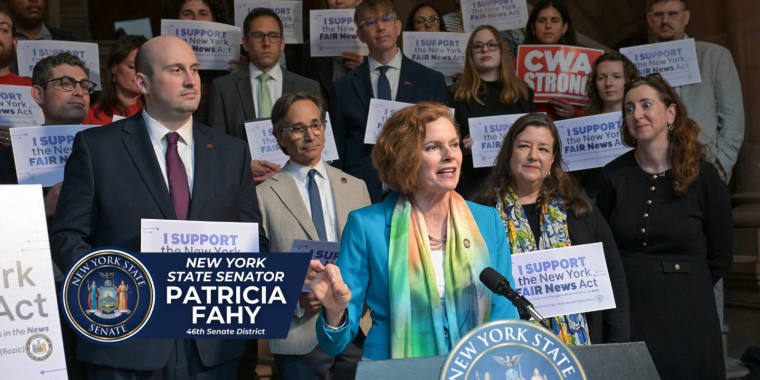
This year, some of that editorial discretion may be limited by law, however. In June, the New York State Legislature passed the Fundamental Artificial Intelligence Requirements in News Act (FAIR News Act), a new bill that would mandate transparency and labeling requirements for newsrooms publishing AI-generated content accessible in New York.
The FAIR News Act has advanced further than any other state-level legislation regulating the use of AI in news media. With New York Governor Kathy Hochul’s signature, it could become law as early as this fall.
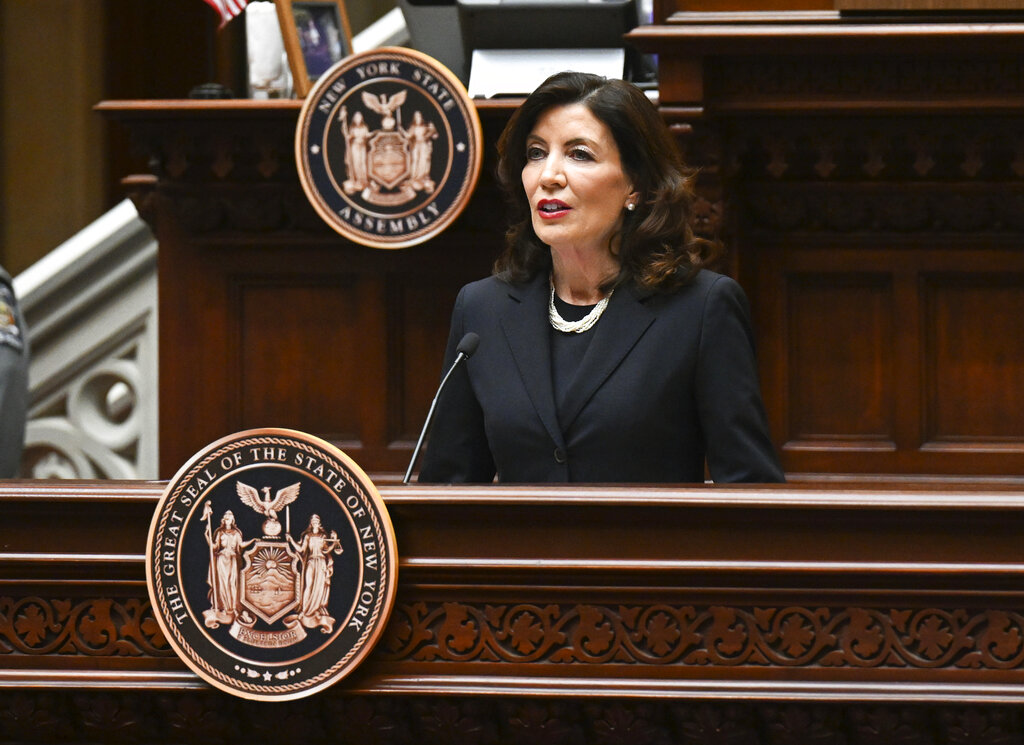
New York Gov. Kathy Hochul delivers her State of the State address in the Assembly Chamber at the state Capitol, Tuesday, Jan. 10, 2023, in Albany, N.Y. (AP Photo/Hans Pennink)
Jon Schleuss, a Chicago Tribune data journalist and current president of the Newsguild-CWA, led the union in endorsing the legislation in May, joining the Writers Guild of America East, Screen Actors Guild–American Federation of Television and Radio Artists (SAG-AFTRA), and the Directors Guild of America (DGA). He says generative AI tools have been useful in his work building interactive stories and organizing data. But these tools don’t automatically meet the high journalistic standards expected of human reporters.
“Our job as ethical journalists is to seek the truth and report it. Large language models don’t understand the difference between fact and fiction. They just understand probability,” he said in an interview, adding that AI also struggles with nuanced ethical obligations like minimizing harm and protecting source privacy. The Guild’s endorsement came just months after the Guild launched its “News Not Slop” initiative and its own set of principles of ethical AI in journalism.
Schleuss says the FAIR News Act will hold newsrooms accountable to their existing internal guardrails and encourage compliance. Currently, “[newsrooms] don’t have to follow their own guidelines. They can change them at will, and they’re not enforceable,” Schluess said.
Critics of the FAIR News Act argue that allowing state officials to dictate what newsrooms do and say and to punish offending outlets is a slippery slope that could threaten newsrooms’ editorial independence, particularly if replicated in more press-hostile states. Others question how the law will keep pace with AI innovation and how it will work in practice.
What the FAIR News Act mandates – and what it leaves on the table
If passed, the FAIR News Act would require that news organizations and journalists clearly label any news media content that is “substantially composed, authored, or otherwise created” by AI and published, disseminated, or accessible within the state of New York.
Earlier versions of the bill included a series of more granular provisions related to job security and journalism ethics, such as privacy safeguards for sources, mandated human oversight of AI systems, and internal disclosure of all AI tool rollouts. The final bill passed by the legislature exclusively focuses on labeling AI-generated content.
In the past few years, legislators have embraced disclosure as an AI regulatory tactic in arenas other than journalism. In California and Illinois, recent laws require employers to disclose their use of AI in hiring and to produce regular audits to combat potentially discriminatory outcomes. Just last month, Hochul signed a law requiring advertisers to clearly label AI-generated synthetic performers used in film and television advertisements.
But Gabe Rottman, vice president of policy at Reporters Committee for Freedom of the Press, says it’s misguided to view business and editorial disclosures as one and the same. “Commercial speech is relatively narrow,” Rottman said in an interview, and is guaranteed fewer protections than political, artistic, or editorial speech or decision-making.
FCC rules have historically required media outlets to disclose business details, such as ownership and investors. But Rottman says the Fair News Act’s leap into editorial content is significant.
“One blinking red light for this particular piece of legislation is that it requires a private speaker – a news entity – to label content in a manner that adopts the government’s preferred messaging,” Rottman said. Though disclosures may appear politically neutral, Rottman says, requiring journalists to publish the use of one specific technology – and not others – in their public-facing editorial content is tantamount to promoting a specific viewpoint.
“It forces them to take a position on this public controversy, and that’s very dangerous under the First Amendment,” Rottman said.
For Rottman, the Act’s enforcement mechanisms raise additional concerns. Under the law, newsrooms and journalists that do not label AI-generated material wouldn’t just be fined but could also be subject to a formal court injunction, allowing a court to halt the publication of any material it deems non-compliant. Rottman says this power may erode editorial autonomy and create a concerning legal opening for political censorship.
“When the government gets in the business of making decisions for news organizations, there’s this temptation to use that power to skew public discourse in your favor. And the New York FAIR News Act carries that risk,” he said. “The concern at the Reporters Committee is that unintended consequences of legislation like this will actually hurt the very people it’s trying to help.”
Defining “substantial” – legally and operationally
Hilke Schellman, an assistant professor of journalism at New York University whose research focuses on the use of AI in hiring, says she empathizes with many journalists’ frustration at the hands-off approach that federal and state governments have taken to AI regulation. The FAIR News Act, Schellman said, is more stringent than existing regulatory frameworks, which typically request voluntary year-end audits of AI use.
But Schellman worries the FAIR News Act’s vague language puts newsrooms at risk of violating the law even when operating in good faith. Schellman takes particular issue with the wording of the legislation, which requires that journalists label content “substantially composed, authored, or otherwise created” by AI.

FILE – The OpenAI logo is seen on a mobile phone in front of a computer screen displaying the ChatGPT home screen, March 17, 2023, in Boston. (AP Photo/Michael Dwyer, File)
“‘Substantial’ is very amorphous. It’s really not clear what that means in day-to-day news practice. Is it a little help from an LLM? Is polishing grammar okay but using it for research is not okay?” she said in an interview. “It seems lawmakers themselves don’t know where the line is drawn.”
Schellman added that this risk is even higher as new uses in journalism emerge that are less conspicuous than an AI-generated news summary. Absent clear definitions of which kinds of tools are and are not admissible penalties could be doled out arbitrarily.
“It’s really tricky for news organizations to decide – and probably impossible for a government regulator to make sense of how much AI is being used in reporting individual articles, podcasts, or videos and in every instance, how it reaches this substance threshold. It makes it really difficult for news organizations, if this becomes law, to follow this law,” said Schellman.
What’s next for FAIR News and AI regulation in news
The FAIR News Act is currently awaiting a decision by Hochul, who must sign or veto it by Dec. 31. If signed, the new law would go into effect 60 days after signing.
But the bill is far from law. In the month since it passed the state legislature, a coalition of free expression organizations and industry associations have urged Hochul to veto it. On June 16, free expression group FIRE (Foundation for Individual Rights and Expression) slammed the bill, arguing that it “invit[es] courts and the Attorney General to police how news organizations and other speakers use emerging technology” and risks chilling critical coverage of the state enforcers. In early June, a group of industry associations, including the New York State Broadcasters Association and New York News Publishers Association, submitted a letter urging New York State Assembly Speaker Carl Heastie to oppose the bill.
The Reporters Committee for Freedom of the Press also plans to send a letter to Hochul opposing the legislation on First Amendment grounds. Rottman, however, clarified that opposition to the FAIR News Act should not be interpreted as a categorical repudiation of AI regulation. In the last two years, union contract negotiations have yielded the most robust AI guardrails in newsrooms. For Rottman, policy advocacy focused on ensuring that state action does not interfere with collective bargaining is one tactic to enable future AI regulation of news – without compromising First Amendment protections.
For supporters like Schleuss, Hochul’s recent support for the AI disclosures in advertising law and the 2024 Local Journalism Sustainability Act, an ongoing $30-million-per-year initiative offering payroll tax credits to local news outlets, is an encouraging sign. In the meantime, Schleuss says the Newsguild will continue to advocate for the union’s ethical AI principles at the bargaining table – and fulfill their role of holding newsrooms accountable.
“There’s the old adage in journalism circles: if your mom tells you she loves you, check it out. I would point to news publishers. If they say they’re going to be ethical about their use of AI, and they release policies and guidelines, we have to check it out,” said Schleuss.