
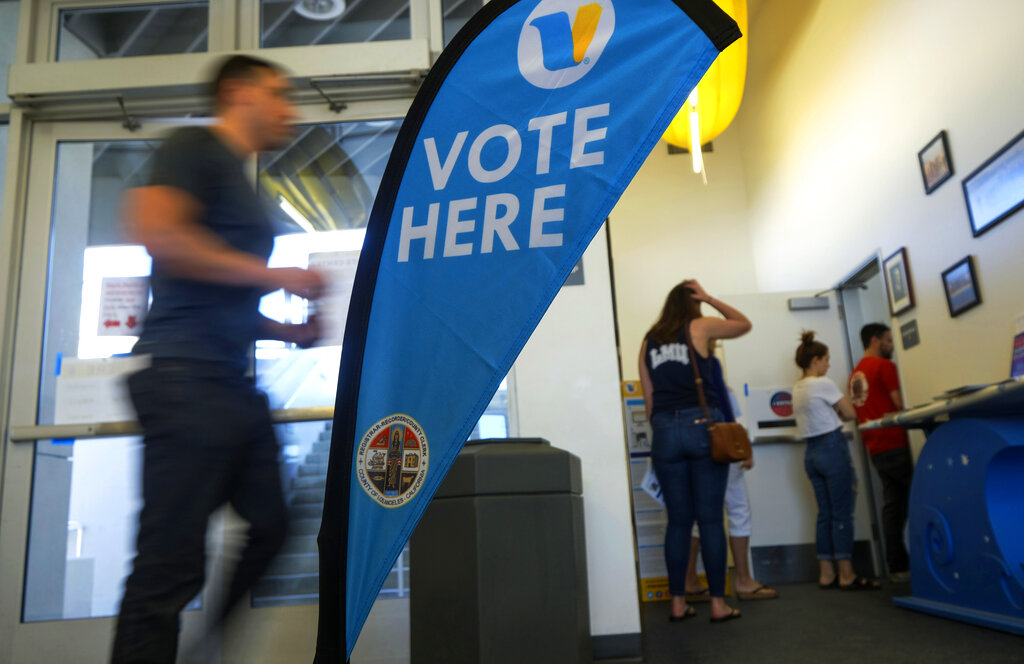

In the run-up to hotly contested elections, Californians flock to the voter guides published by CalMatters, a statewide not-for-profit newsroom.
About 3 million people checked out CalMatters’ guide to the recent California gubernatorial primaries, according to CEO Neil Chase. CalMatters’ short videos explaining California ballot propositions, in both English and Spanish, routinely draw hundreds of thousands of views across a plethora of social media platforms, Chase said. Same with the site’s video interviews with major candidates and its interactive quizzes helping voters identify the candidate whose policies most closely align with their views.
The key to the success of CalMatters’ long-running guides, Chase said, is the newsroom’s commitment to factual, nonpartisan reporting. The goal, Chase said, is to give readers and viewers the information they need to inform their voting decisions.
“Providing information that people find useful is going to rub off well on the news outlet that does it and on journalism in general,” Chase said. “And not being seen as the organization that is fomenting the discord has got to be good for us.” (Interestingly, when one candidate used the opportunity of a CalMatters’ video interview to criticize the news site, CalMatters opted to air his criticism.)
Many other state and local newsrooms have reached the same conclusion, publishing election guides that range from straightforward information about who’s on the ballot and how to cast a vote to extensive reporting on candidates and ballot initiatives. As the Institute for Nonprofit News discussed in a story after the 2024 elections, voter guides can be a uniquely effective way for local newsrooms, especially in rural areas, to boost engagement – and credibility – with their audiences.
Local elections, after all, receive little coverage from national news outlets, leaving an information vacuum for smaller newsrooms to fill with authoritative information for voters who want to make knowledgeable choices. In fact, newsroom leaders consistently say that their guides to local contests receive more traffic than posts about statewide and national races.
But any outlet whose election-guide ambitions exceed simple instructions about how to cast a ballot will likely face an overarching ethics question: How can you assure that your coverage is balanced and accurate, given varying degrees of cooperation from candidates?
The Ethics and Journalism Initiative talked, in addition to Chase at CalMatters, to three editors who oversee comprehensive voter guides – Maria Mendez at The Texas Tribune, Carson Walker at South Dakota News Watch, and Dwayne Yancey at Cardinal News – to find out how they’re navigating ethical issues that arise from their coverage.
Surveying the field
Yancey’s Cardinal News focuses its coverage on 50 counties in rural Virginia. For this year’s vote guide, however, Yancey decided to send questionnaires to every candidate running for a local, state, or federal office in all of Virginia’s 113 cities and counties, from a U.S. Senate race all the way down to school board elections. (That undertaking was made all the more complicated by litigation over the proposed redistricting of Virginia’s Congressional map, which led some candidates in Congressional primaries to change their minds about where and whether to run.)
In the cities and counties that Cardinal News covers closely, Yancey said, Cardinal News tailored its questionnaires to include issues of particular concern to local residents. Roanoke City Council candidates, for instance, were asked for their views on a proposed casino and entertainment district.
The news outlet posed broader questions to Congressional candidates, who will face off in primary elections in August. Yancey’s questionnaire asked for candidates’ views on hot-button state and national issues including immigration; the Gaza and Ukraine wars; health care and rural hospitals; and energy policy.
Candidates’ responses to the questionnaire, Yancey said, were automatically uploaded, via special software, to the news site.
“That is not a substitute for real reporting on some of these races,” Yancey said. “But it is, at least, a bare minimum way to acknowledge that they’re going on and try to provide people with some bare minimum information.”
Yancey said he tried hard to keep questions nonpartisan, although candidates from different parties may have quite different answers. The point, he said, was to get candidates to address provocative issues that matter to voters on both sides, giving voters enough information to distinguish among the options.
Not every candidate responds, Yancey said. Candidates running for federal offices have a high response rate, he said, but local candidates with small campaign operations sometimes don’t send answers. Cardinal News tells readers that it received no response from those candidates. Yancey told me that in some local races, voters have pressured non-responding candidates to fill out their questionnaires.
The questionnaire approach could lead to ethics problems. What if, for example, a candidate’s survey responses contrast with her legislative record? Or what if a candidate used his survey as a vehicle to attack his opponent? Yancey said that for the most part, Virginia candidates seem to be answering questions in good faith, although he said he did recently use an editor’s note to point out that a candidate’s answer cited factually incorrect data.
And if a candidate misuses the survey, Yancey said, Cardinal News can write about it. “We’ll cross that bridge when we get to it,” he said.
The reportorial voice
Walker of the South Dakota News Watch told me that even if he wanted to rely on candidate questionnaires to inform readers of his newsroom’s voter guide, he couldn’t – because his state’s politicians often don’t respond to press queries.
But Walker said, in any event, that he doesn’t want the News Watch’s guide to serve as a platform for statewide candidates to trot out their campaign pitches.
“Part of me not wanting to do surveys is to not give them the idea that they’re doing me a service by answering pat questions instead of sitting down for an hour long interview and really probing what they think and what they would do about some of the problems,” Walker said. “So, as this evolves, and if and when I get a reporter that will stay with it, I want it to have watchdog journalism and to really detect and call out lies as we see them.”
The News Watch guide, in addition to providing basic information about how and when South Dakotans can cast their votes, features reported profiles and stories about candidates for statewide offices. (The newsroom does not have the capacity right now, Walker said, to cover local races.) Walker said there may eventually be a place for Q&As with the candidates, but “it’s been so misused that I’d rather have less coverage [like that] and more of our own reporting.”
When it comes to ballot initiatives, News Watch at the moment relies on descriptions of the issues from the state’s attorney general. Walker said his goal is to replace those legalistic descriptions with balanced and easily-understood, multilingual descriptions that are reported by staffers and published across a variety of platforms.
“It is worth taking our time and really vetting the ideas and the candidates and things to do that original reporting,” Walker said. “It is a public service. And we can do it as journalists: Hold these people accountable and explain things in a way that does not look down and that gets people engaged.”
Texas Tribune’s hybrid approach
When Maria Mendez took over The Texas Tribune’s annual voter guide in 2022, it focused on voting processes and procedures, a valuable service in a state where casting a ballot can be complicated. But in the last few years, based in part on feedback from readers, the Tribune has begun expanding the project to include thumbnail profiles of major candidates for statewide offices and deeply reported explanations of ballot initiatives to change the Texas constitution.
For the thumbnail profiles, Mendez created a template that Tribune journalists could fill with public-record information about candidates’ background, experience, endorsements, and campaign donors. In addition, the Tribune sent a survey to major candidates in the recent U.S. Senatorial and Texas Attorney General primaries, asking candidates from both parties to supply written responses to several questions.
Many candidates responded, Mendez said, but some did not, including the two candidates who faced off in May in a runoff for the Republican U.S. Senate nomination. In instances when candidates did not fill out Tribune surveys, Mendez said, reporters combed through their public statements to fill in answers whenever possible.
The Tribune is notably transparent with voting guide readers, explaining how it conducted the surveys, who responded, and how journalists sought to supply answers based on nonresponsive candidates’ public statements. “We wanted to make sure people weren’t confused or didn’t think, like, ‘Oh, you only interviewed the Democrats,’” Mendez said.
The news site also ran an editor’s note explaining why the Tribune opted not to cover every candidate for major offices. And when the Tribune received a candidate headshot that appeared to have been manipulated with artificial intelligence, it published a story about candidates’ use of AI in political ads – and included a statement of the Tribune’s internal policy of not running photos or videos that employ generative AI.
That story accords with Mendez’s belief that the Tribune has an ethical obligation not just to provide information about candidates but to use its guide to provide insight about the election process. Before the March primaries, the news site ran a piece explaining the vote-counting process, in the tradition of a 2022 story about election security.
“We try to explain not just the voting process and our elections,” Mendez said, “but also how election administration works.”
Takeaways
- Prioritize balance and nonpartisanship. Give candidates from all parties equal opportunities to respond to questions, whether through surveys or interviews.
- Craft questions carefully to avoid any hint of partisanship.
- Do not allow candidates to assert false information. If a candidate says something that isn’t true, give the candidate a chance to correct the information. If the candidate declines to do so, include an editor’s note alerting readers to the inaccuracy.
- Be transparent with your audience. Explain your methodology and tell readers whether candidates responded to questions.
- If your guide includes summaries of ballot initiatives, present arguments by both supporters and opponents.
- Consider using multiple social media platforms and, if relevant, multiple languages, to maximize your guide’s reach.