
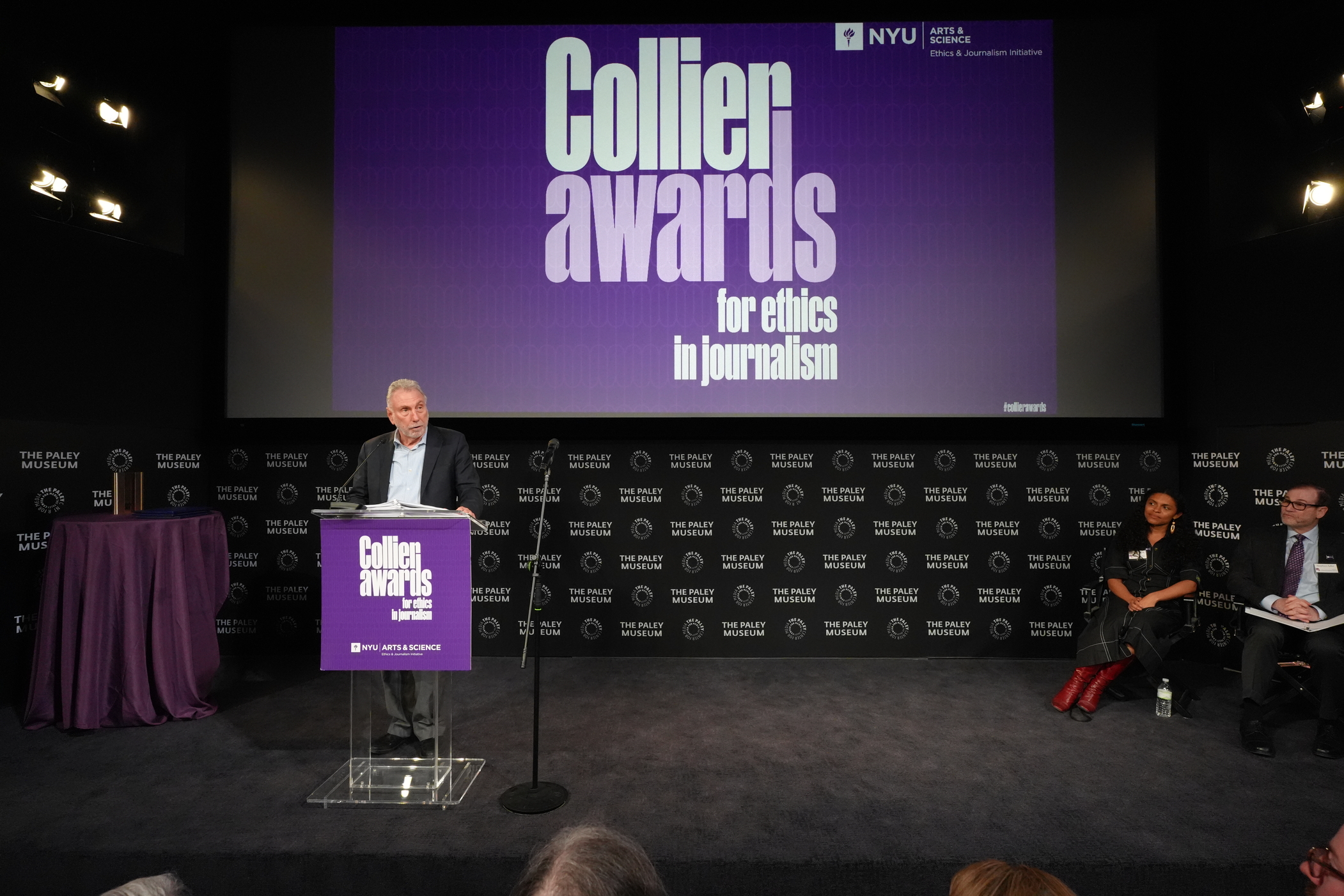
Many thanks for allowing me to join in this celebration of journalism that meets the highest ethical standards.
I admire how Steve has built a program on the ethics of our profession. The subject warrants the attention he and NYU are giving it. Especially now when our field is under incessant attack, when our ethics are regularly questioned. Especially since ethical quandaries seem to confront us every day. And especially when so many journalists assail the ethics of others in their own profession.
Every profession needs an ethical compass. I worry that we can’t agree on ours. And that the evolving ethos in a time of fragmented media appears to be: To each his own. Ours is a profession at risk of having no shared ethical compass at all. We will do ourselves no favors if that turns out to be the case. All of us will likely be tainted by the worst practices of any one of us.
I confess, I was hesitant to take on this topic of ethics. When Steve contacted me, I had to think a good while before accepting his invitation. The risk of sounding sanctimonious is high. And I really wondered if I could fill 15 minutes or so with thoughts that deserved your consideration. After all, many of you are here because your own ethics are judged prize-worthy. But Steve is persuasive. I couldn’t say no.
I’d like to propose that we agree on at least some things as our ethical compass. And while there are any number of principles I could nominate, I’m going to argue today that we begin by agreeing on two. Both, I believe, require a renewed commitment.
I began my full-time career as a reporter in 1976 at the Miami Herald. It was one of the many papers built by brothers Jack and Jim Knight, who together created one of the biggest and most respected newspaper chains in the country. Jack Knight, who himself won the Pulitzer Prize, had a simple motto: “Get the truth and print it.” That spirit informed all that we did at the Miami Herald.
Jack Knight said something else about our mission. The truth would not always be welcomed. We had to expect that. And we had to accept that. “The truly distinguished newspapers in this country,” he said in 1969, “are those which have dared to face public wrath and displeasure.”
So that, to me, is the first ethical principle of journalism, the most fundamental: Get the truth. Let the facts land wherever they may. Tell the public what you’ve learned. And don’t let fear deter you. Not fear of politicians. Not fear of others with the power to make your life miserable. Not fear even of the public, or of how our work will be received by our most loyal audience. And not fear of political consequences that many of us might lament.
Toward the end of my full-time journalism career, I came across another principle drafted by a newspaper owner. It, too, made a profound impression. That was at The Washington Post, where I spent more than eight years as the executive editor. The principle appeared on the wall as I walked into the newsroom. It was the first among seven original principles articulated for The Post in 1935 by Eugene Meyer, who had bought the paper out of bankruptcy two years earlier. The word “truth” was prominent there, too. More as an ideal, though, than a result we were certain to achieve. The principle reads: “The first mission of a newspaper is to tell the truth as nearly as the truth may be ascertained.”
That last phrase stuck with me. And it frames what I believe should be a second pillar in a set of ethical standards. While there is such a thing as truth, and we aim to uncover it, getting at the truth is a process. It is hard. It takes time. We almost never immediately know it, and we can’t assume we ever know it in full. If we’re honest, we’ll admit that we often see the world through a keyhole. With work and skill, we can open the door a bit and see more. With more work and more skill, and perhaps a lot of luck, we can swing the door wide open and see what appears to be the whole picture.
Given that we are not all-knowing, we have the obligation of always listening, looking and learning — consumed by what remains to be discovered and how we can effectively meet the public’s information needs. The best journalism, from what I’ve observed, comes from being unsettled — and motivated — by the questions we have yet to answer as opposed to being smug about what we know (or think we know). The truth may not be what we suppose or what we prefer. Humility and curiosity increase the odds that we’ll get things right. And because we acknowledge our fallibility, we must correct ourselves when we don’t.
It’s long been said that journalism is the “first rough draft of history.” That is a phrase often attributed to former Washington Post publisher Philip Graham in the 1960s but that probably has its origins all the way back to 1905. As often as we repeat those words, we would do well to reflect more deeply on them: What we do is a draft. It is an early cut. And it can, yes, be rough.
The two ethical pillars I mention suggest a balance in how we might think about our work: Determination balanced against doubt. Determination to get at the truth. Doubt that we have it in full. Not doubt that is paralyzing. Rather, doubt that reinforces a determination to learn what we still don’t know.
Each of us can think of stories that fulfilled the first principle of telling the truth despite enormous pressure. I grew up in journalism during the era of the Pentagon Papers and Watergate. The New York Times, followed by The Washington Post, fought the federal government all the way to the Supreme Court to publish a classified history of the war in Vietnam. Through the Pentagon Papers, the public learned of the failures its government had covered up during a long war that cost so many lives.
And then there was Watergate, an investigation spearheaded by The Washington Post. The Post’s journalists were condemned as politically motivated. Its publisher, Katharine Graham, faced threats to the company’s business interests. And yet The Post persisted. The public learned how the president had weaponized the government against his adversaries. How he had abused his powers and sabotaged the Constitution. Because of The Post’s work, and because of a Congress that in that era fulfilled its oversight responsibilities, Richard Nixon resigned.
In a run-up to war in 2003, the Knight Ridder bureau in Washington published dozens of stories that debunked claims of the George W. Bush administration that Iraq possessed weapons of mass destruction. Those journalists didn’t stop the war, which wasn’t their job. They did inform the American public, which was — even though, tragically, neither the public nor politicians took their work to heart.
In February, I was pleased to interview Julie K. Brown of the Miami Herald. She and the Herald in 2018 defied the rich, the powerful and the politically connected to revisit the case of Jeffrey Epstein, reconstructing how he had received shockingly lenient treatment for what was so clearly a case of sexual abuse and sex trafficking. The worldwide impact of her work ethic – and her journalistic ethic – continues today.
And, naturally, I think back to our work at The Boston Globe in unearthing a decades-long cover-up of sexual abuse by clergy in the Catholic Church. We embarked on that investigation even though the population of the Boston area was disproportionately Catholic, even though the Church then represented probably the most powerful institution in New England, and fully expecting that the Church would level allegations of anti-Catholicism against the Globe, just as it had in the past. The prospect of fierce community backlash was immense.
A couple of years after we published that investigation in The Boston Globe, I received a letter from Father Thomas P. Doyle, who had long waged a lonely battle within the Church on behalf of abuse victims. “This nightmare,” he wrote, “would have gone on and on were it not for you and the Globe staff.” I kept Father Doyle’s letter on my desk in Boston as one more reminder of the fundamental principle of our work: “Get the truth and publish it.”
Of course, there are examples of our failures, too. We should acknowledge them. I mentioned the great work of Knight Ridder’s DC bureau as the country marched toward its 2003 war in Iraq. But other leading news organizations failed to dig in the same way, failed to seek the truth. They accepted — without necessary skepticism, without sufficient reporting — the Bush administration’s ominous claims about Iraq’s weapons capability. Perhaps they were too gullible. Perhaps too willing to swallow the assertions of high-level official sources. Or perhaps too fearful that the government and the public would excoriate them for a perceived lack of patriotism. Many Americans ended up seeing that journalistic failure as a dereliction of duty. I agree. It was.
Each of us probably can point to other instances where we went astray. Here’s one to think about: Did we live up to our truth-seeking mission early this decade as we saw Joe Biden struggling cognitively and physically while holding the most powerful position on earth? I don’t believe we did. Did some among us shy from aggressively exploring his intellectual acuity and physical health for fear of aiding Donald Trump’s campaign and alienating loyal readers, viewers and listeners? My guess is yes. If so, would that be an ethical breakdown in our profession? Again, I’d say yes. One thing is for sure: Our credibility was damaged.
Now we are living with an administration that actively obstructs our search for truth. President Trump and his allies seek to extinguish all independent arbiters of fact. The press is among them. So are judges, scientists, scholars, government statisticians and many others. Data itself is targeted. Trump lies about it. He also manipulates it, suppresses it, and goes so far as to erase it. Facts are the enemy he dreads most.
The response to all of that, I believe, is to keep doing our job. Not as warriors but as professionals who adhere to the highest standards even as we demonstrate unshakeable resolve. Because the First Amendment was drafted by the founders based on the firm belief that vigilance over public officials and the most powerful was essential. It is an ethic at the very core of the republic they established. They tasked the press — all Americans, for that matter — with that responsibility.
If one challenge to that ethic of vigilance is the president’s malicious war on the media, another comes from those who enjoy press freedoms but abdicate the corresponding duties. I’m talking, for instance, about cable networks that function as mouthpieces and bullhorns for the administration, who routinely funnel on-air personalities into its top positions and who supply them with lucrative landing spots when they exit. These outlets render themselves largely indistinguishable from the government they are supposed to cover.
I’m also talking about so-called independent journalists who serve as the administration’s stenographers and propagandists. Among the worst are those who obediently signed contracts demanded by the Department of Defense in exchange for a press seat at the Pentagon. In doing so, they consented to ask no questions, do no reporting and produce no stories on matters the Pentagon doesn’t bless with an official release.
If the founders of this country had wanted lapdogs in lieu of watchdogs, they would have at least hinted at that in the formative documents that are their legacy. Those documents had deep flaws, but that was not among them. Stenography and propaganda are clearly not the ethic of the First Amendment.
Finally, I’ll mention a mindset in vogue among a certain crop of media executives. Although they claim to want politics out of the newsroom — and I do, too —they simultaneously propose a political calculus for their journalists. The new owner of CBS and the current editor-in-chief of the news division, for instance, set an explicit objective of appealing to the center right and the center left. That is a political goal. It is not a journalistic one. And it is a far cry from how Jack Knight instructed his newsroom: “Get the truth and publish it.” That is a journalistic goal.
Media owners who substitute political goal posts for news values find refuge in sophistry. They lay claim to ethics; instead, they subvert them. Their path may be one of commercial convenience. Or of timidity. Or of appeasement to regulators, legislators and the president himself. Or the instinctual path of those who see the press only through the lens of politics. But a news outlet of that formulation is fated to compromise ethics when a rock-solid story moving toward publication is deemed to fall outside the designated political comfort zone.
Accurate, independent, ethical coverage may be well received by the center right, or it may not. It may be well received by the center left, or it may not. No one should set out to alienate anyone. But at times, as Jack Knight said, the best journalism may end up facing “public wrath and displeasure.” That is the price, at times, of honest work. So be it.
Doing work that is bold, impactful and even provocative requires, I believe, that we also respect the second ethical pillar I mentioned earlier. At its essence, it is this: Let’s admit we are not perfect in our judgments. We’re not always correct in our assumptions. We’re not omniscient. Those who behave as know-it-alls and imagine themselves to be moral authorities leave the public with an impression that no journalist is any different. They, too, often lay claim to ethics even as they subvert them.
While both legacy and new media can boast of authoritative voices, both are also amply populated with media figures (on the left and right) who see everything through a partisan lens; who need no more than minutes to conclude who is right and wrong; who seize on an isolated fact to make sweeping judgments; who (if they interview at all) consult only those who tell them what they wish to hear; who aim primarily to showcase their purported virtue; who are allergic to nuance and complexity; who rush to label others with a pejorative; who summarily categorize people and institutions into good and evil as if the world were always so simple. Theirs is an outrage and advocacy industry, not a fact-finding profession.
I’m here to argue for taking a breath, for keeping an open mind, for giving weight to patient reporting over assumptions and impulsive commentary. Much is not as it first seems. My concern is the same as what Dean Baquet of The New York Times expressed in his keynote remarks at this event last year. “I fear,” he said, “that reporting itself — the act of going out into the world open-minded, humble and empathetic — is in deep trouble.” We must do that reporting, and do it in that way, Dean said, “because it is the ethical and honorable way to pursue the truth.”
Some years ago, Dean spoke about this by quoting Jason DeParle, the superb reporter who had covered poverty for The New York Times: “The great lesson of reporting,” Jason said, “is that the world is almost always more complicated and unlikely than it seems while sitting at your desk.”
Conor Friedersdorf wrote in The Atlantic magazine in 2021: We could all get out more and learn from conversations with people who are not like us . . . [B]efore drawing conclusions about any group of people, we should all strive to make sure we’ve talked with some of them face-to-face.”
Former Washington Post reporter Paul Taylor once told author, journalist and university professor Tom Rosenstiel that before doing his reporting he would write down what he thought the story would be. “When he was done with his reporting,” Rosenstiel recounted, “he would check what he had written. If he still thought the story was exactly the same as when he set out, he knew he hadn’t done enough reporting.”
The reflections of these superb reporters do not signal a failure of will to call things as they are. They are not a sign of any moral weakness. They are a sign of strength. Of maturity. Of integrity. And they suggest that while ethics can be codified in a workplace manual or debated in academic settings, they will always be field-tested with every single story we pursue.
The best journalists will have regular, honest, often tense conversations with their own conscience. Their conscience will be shaped by a candid appraisal of our profession’s successes and its failures. And it will be built, above all, on the most sincere personal desire to get things absolutely right.
This evening it is an honor to be among journalists who rank among the very best. Thank you for having me.