
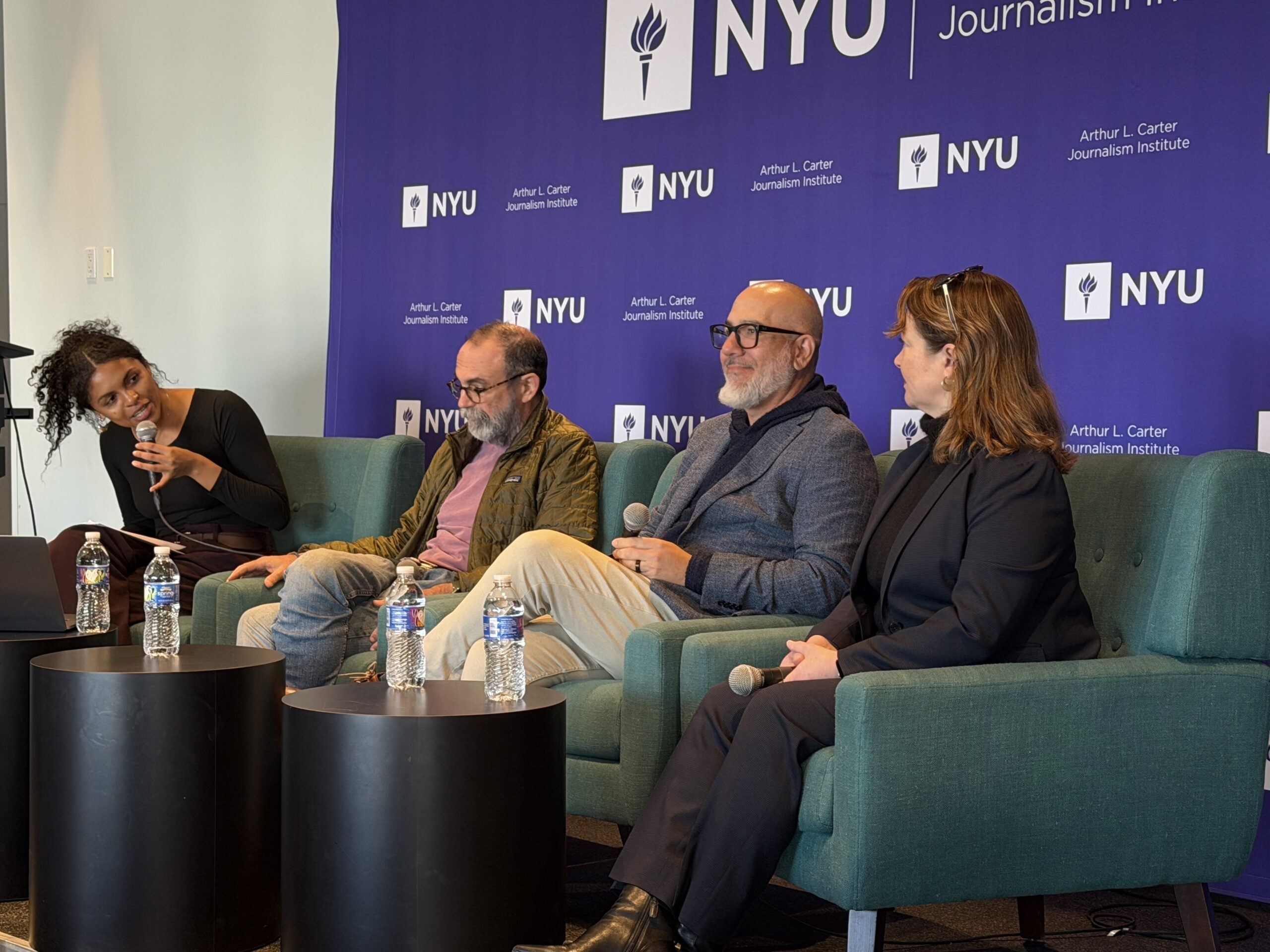

When the Boston-based public radio station WBUR conducted a survey in 2023 to find out what its journalists thought about the use of generative AI, one anonymous respondent offered a succinct answer: “Please, I beg you, do not let the bogeyman through the front door,” recalled WBUR chief content officer Victor Hernandez, speaking at a Nov. 10, 2026, Ethics and Journalism Initiative panel on AI’s use in newsrooms. “AI is coming for us all.”
Hernandez relayed that story not to endorse his anonymous colleague’s doomsday warning but to emphasize how quickly journalists’ attitudes toward AI are changing – a perspective shared by his fellow panelists Eileen O’Reilly, the head of standards and AI practices at Axios; and Maurice Tamman, a Reuters investigative reporter and data journalist. It’s been only four years since what Hernandez called the “bogeyman era,” but as EJI deputy director Ryan Howzell pointed out in her introduction to the discussion, AI is already on its way to mass adoption: Eight of this year’s Pulitzer Prize winners and finalists, Howzell noted, disclosed that they’d used AI in their award-winning stories.
Howzell guided Hernandez, O’Reilly, and Tamman through a wide-ranging discussion of the boundaries newsrooms should set for AI usage; how newsrooms can incorporate AI into their reporting processes in ways that can make journalists more ambitious and efficient; how to think about disclosing AI use to audiences; and panelists’ biggest fears about the technology.
“In 2021, when I first turned on my first interaction with a large language model, I knew in that instant that the world had changed for our industry,” said Tamman. “It has been an integral part of my professional experience now for five or six years, and I don’t regret it, although it scares the hell out of me.”
Hernandez and O’Reilly have dedicated significant time in the last couple of years to drafting (and revising) AI guidelines for their newsrooms. Both WBUR and Axios have developed standards that encourage journalists to use AI – particularly to enhance their efficiency and improve their reporting processes – but require that content must ultimately be the work of journalists, not machines.
O’Reilly offered the example of Axios reporters using AI to help pull together event calendars or news roundups for local newsletters. (Axios journalists, she noted, must still fact-check the items and be sure they’re not plagiarizing.) The key, she said, is “finding these little ways to make our reporters’ lives a lot easier, but still where we can maintain our editorial trust.”
Hernandez said that WBUR’s standards are intended to leave room for journalists to experiment with AI for research, newsgathering, presenting stories graphically, and other background tasks while respecting the directive that all content must be crafted by journalists.
“It’s not so much that we’re giving people paint by numbers of, okay, pull out your LLM, and this is the six-step process for getting to your story deadline,” he said. “It’s really about what we stand for, and what the margin of out-of-bounds looks like, with so much room for discovery and conversation in between.”
Tamman decided five years ago that generative AI would have as profound an impact on journalism as the internet. He began experimenting when large language models still made obvious mistakes, such as hallucinating stories Tamman had supposedly written and even providing imaginary URLs for nonexistent articles. In the early days, Tamman said that although he used AI to assist in the coding and research he was already doing as a data journalist, he had to be vigilant about catching its many mistakes.
But in the years since, Tamman said, AI has become an intrinsic part of his reporting. Tasks like transcribing interviews, organizing masses of notes, and writing summaries of his findings used to take weeks or even months, Tamman said. Now, with AI’s help, he can accomplish this background work in a matter of hours.
Even more substantively, Tamman said, AI allows him to write deeper, more sophisticated stories than he could without using the technology. His most recent series for Reuters, The Age of Heat Storms, made use of tools and research, Tamman said, that in the past would have been accessible only to academics. “It’s really quite remarkable how much more muscular I feel my journalism has become,” Tamman said.
Tamman raised a point that will become ever more pressing as newsrooms expand their use of AI. At the moment, many news outlets distinguish between the use of AI for research,transcription, summarization and other processes and its use to write headlines and stories. Tamman said, however, that when he uses AI to help summarize his research, it produces written reports that he finds it helpful to read. Yet ethical principles preclude him from using its words in his actual stories
“How do I defend against that?” he said. “It’s not always as easy as you might think.”
Robust disclosures, said O’Reilly and Hernandez, can help audiences understand where newsrooms are drawing lines when it comes to AI use. Hernandez advocated for telling audiences not only specifics about how journalists used AI to help with a story, such as in the generation of an initial transcript of a radio show, but also how the time saved by using AI enabled journalists to do other things that AI can’t. Hernandez said WBUR’s disclosures emphasize that its journalism is always crafted by humans.
There is no doubt that AI presents huge challenges to the news business. Tamman said he worries that young reporters and editors won’t have the opportunity to develop the skills he needed to understand how best to use AI and to avert its potential pitfalls. Hernandez said AI apps that draw from multiple sources to customize news feeds could cannibalize local journalism. O’Reily said she worries that AI news feeds will reinforce readers’ pre-existing beliefs, keeping news audiences trapped in their own bubbles.
But that’s precisely why the craft of journalism remains so important, O’Reilly said. Reporters notice things that machines do not. They develop sources whose information is not already accessible to large language models. And they talk to people – including ordinary people – to find out what’s happening in their lives.
“We want people to be exposed to different ideas, different perspectives, to think outside the box,” she said, adding that AI can give journalists more time for essential reporting. “We’re in such an amazing time for journalism right now.”