

The past 12 months confirmed for us at the NYU Ethics and Journalism Initiative that our mission is more vital than ever.
The dubious ethics of some celebrity journalists may have grabbed headlines last year, but most of the people in our industry are trying every day to uphold their commitment to produce important, trustworthy journalism in the face of ethical challenges. EJI spent 2025 supporting and celebrating their efforts.
Consider, for example, our training program. We began 2025 with the mere outline of a plan to develop ethics workshops that would help reporters identify and grapple with ethical challenges such as covering migrants and other vulnerable sources; dealing with AI and image manipulation; and drawing a line between journalism and advocacy.
We spent the early part of the year talking to industry leaders and editors, mostly at local startups, about whether there’s an appetite for ethics training and, if so, what form that training should take. Based on what we learned from those interviews, we decided our role should be to lead discussions about ethics, not to lecture reporters and editors about what they should and shouldn’t do.
Over the summer, we developed a comprehensive set of ethics scenarios and follow-up questions, all rooted in real-life examples of reporting challenges. Our hope was that the hypotheticals would provide a lively way to talk about issues like minimizing harm to sources, conflicts of interest, corrections, and the boundaries of a journalist’s role.
Then came the hard part: actually conducting workshops. Our first session was via Zoom with corps members from Report for America. Next was a virtual workshop with reporters and editors at Morning Brew, for which we developed a specialized session focused on source development and relationships. In November, we traveled to Boston for two sessions with journalists at WBUR. Finally, in December, we led an in-person workshop for the team at the newly-launched L.A. Local. In all, about 200 journalists have so far participated in our ethics workshops.
It’s been particularly gratifying to hear from experienced reporters and editors who told us that they rarely have an opportunity to talk with a big group of colleagues about ethics issues, even though these issues arise across the newsroom.
We’ve learned a lot from our first round of workshops. We’ve honed our hypotheticals to make them even more timely and challenging, and we’ve realized that it’s more fruitful to allow plenty of time to discuss each scenario than to rush to new topics. Our 2026 workshops promise to be even more effective than our initial forays.
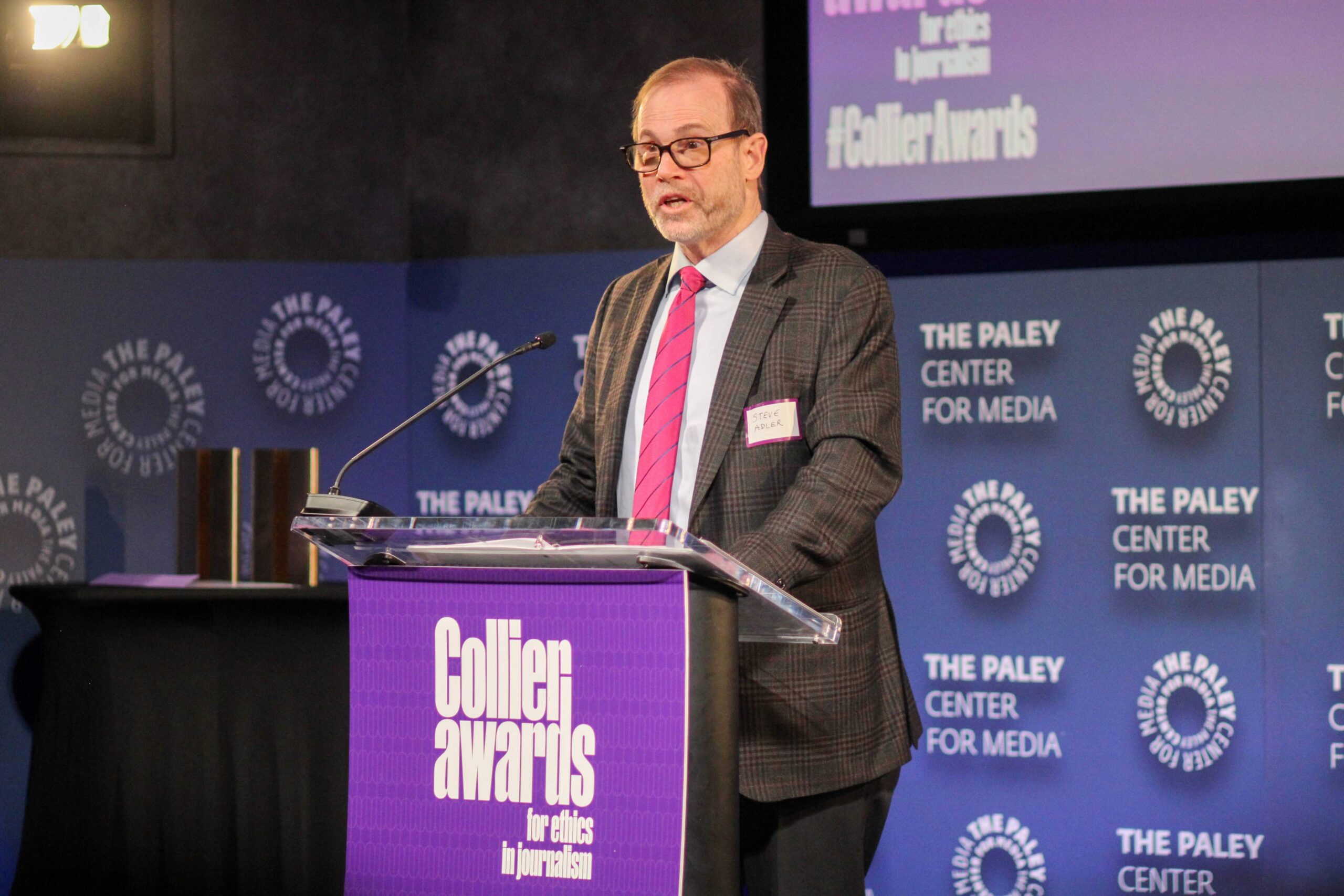
A year ago, we were poring over more than 100 submissions for our inaugural Peter F. Collier Awards for Ethics in Journalism. After our distinguished judges panel, chaired by Gina Chua, executive director of CUNY’s Tow-Knight Center, picked award winners in our three categories – student, local, and national/international journalism – we celebrated their work, both at a gala ceremony last April at The Paley Center for Media and at a symposium at New York University in which awardees talked about navigating ethics challenges to produce great journalism.
We’ll be honest: We worried that we might hit a sophomore slump with this year’s Collier applications after our big push in our first year. We did not. Our overall pool of applicants was nearly 20% bigger. We were especially excited about this year’s submissions in our local news category, which includes nearly twice as many submissions as last year.
We won’t be announcing winners for a couple of months, but our preliminary screening was incredibly heartening. Reporters and editors across the country are thinking hard about ethics and turning out fantastic stories that reflect those considerations.
EJI continued in 2025 to host provocative panel discussions at NYU about pressing ethics issues, including a program on how to report on campus protests; a discussion with eminent foreign correspondents about the ethics of international coverage; and a panel of environmental journalists who talked about the ethical challenges of writing about climate change.
All of our efforts helped raise EJI’s profile in 2025. Our founder and director, Stephen J. Adler, was one of the journalists selected to advise the Society of Professional on the revision of its vastly influential ethics code. Adler also delivered the keynote address at a Spanish conference on journalism and good governance; and joined Rappler founder and Nobel Peace Prize winner Maria Ressa, Executive Director of the Craig Newmark Center for Journalism Ethics and Security Margaret Sullivan, and Columbia Journalism School professor Sheila Coronel in a fascinating Lipman and Stabile Center discussion of whether journalists should actively promote democracy in the face of authoritarianism.
In addition, Adler has become a key commentator on journalism ethics. He was quoted in a November story in The New York Times about AI in newsrooms; a CJR piece in August about changing ethical standards in journalism; and an analysis in The Wrap in August that considered when, in the Trump era, journalists should consider leaving their news outlets. EJI’s guidance on correcting errors was cited by the Concord Monitor in an October story about correcting errors.
It’s been a remarkable 12 months for EJI. We can’t wait to build on that momentum in 2026.